We Are NOT Evolving
What a New Genetics Study Actually Shows

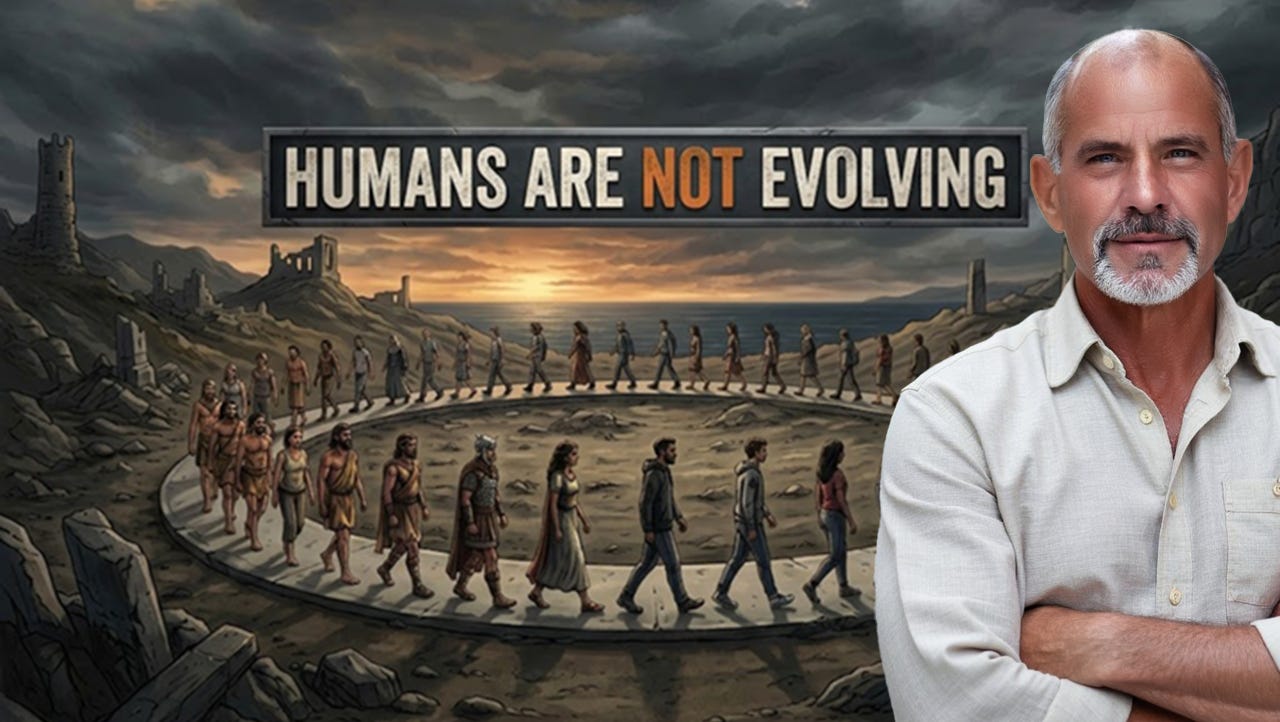
A major new study just made headlines claiming that humans are still evolving. That we’ve changed dramatically in the last ten thousand years. That our skin, our immune systems, even our brains have been reshaped by natural selection since the end of the last ice age. The article put it like this; “… we are not simply cavemen wearing suits; we are different beasts altogether.”
Striking claim.
As Christians, we need to ask the right question about a claim like that. Not, “Is it scary?” Not, “Does it threaten my faith?” The right question is simpler. The right question is, “Is it true? And what exactly is being claimed?”
Here’s what we need to see. There’s a quiet sleight of hand happening in the way this research is being reported. And once you see it, you’ll notice it everywhere — in nature documentaries, in science magazines, in your kid’s biology textbook. Once you see it, you can’t unsee it.
So let’s talk about what this study actually found, what it didn’t find, and why a Christian doesn’t have to be afraid of any of it.
WHAT THE STUDY ACTUALLY DID
Here’s the background.
A team of researchers at Harvard, led by a scientist named Ali Akbari, published a paper in the journal Nature. They worked in the lab of David Reich, who’s one of the leading figures in ancient DNA research in the world today. Whatever you think of his conclusions, the man’s lab is doing serious work.
What they did was remarkable. They analyzed ancient DNA from nearly sixteen thousand people who lived in Europe and western Asia over the last eighteen thousand years. Sixteen thousand people. Think about that. We’re talking about pulling genetic material out of bones and teeth recovered from archaeological sites — people who lived at the end of the ice age, people who lived through the rise of farming, people who lived during the Bronze Age, all the way up to the modern era.
And when they compared all that genetic data, they found something interesting. They identified four hundred seventy-nine specific places in the human genome where the genetic mix in the population shifted in a clear direction over time. Not random fluctuation. Real, sustained change.
What kinds of traits are we talking about?
Skin color.
Eye color.
Resistance to certain diseases.
Tolerance for milk.
Susceptibility to celiac disease.
Then it gets controversial. They say they found shifts related to things like -
Schizophrenia risk,
Bipolar disorder risk,
Traits associated with educational attainment and intelligence.
That last part — the cognitive stuff — even other geneticists are pumping the brakes on. A scientist named Iain Mathieson, who trained in the same lab, has publicly questioned whether the methods used can really separate genuine selection from random statistical noise. Even within the field, the cognitive findings are contested.
Let’s set that controversy aside. Let’s grant the whole study and assume every finding is rock solid. The question to ask is, “What does this actually prove?”
THE WORD “EVOLUTION” IS DOING TWO JOBS
Here’s where the sleight of hand happens. You have to listen carefully, because the word evolution gets used in two completely different ways, and most people don’t realize they’re switching between them.
The first way the word is used means small-scale change within a kind of creature. The mix of traits in a population shifts over time. Some traits become more common, others become less common. The classic example everybody learns in school is the moths in England — the peppered moths — that shifted from mostly light-colored to mostly dark-colored when the Industrial Revolution covered the trees in soot. The dark moths blended in better, so birds ate fewer of them, so they had more babies, so dark moths became more common.
Notice something. The dark moths were already there. The genes for dark coloring already existed. What changed was the proportion. Same species. Same kind of creature. Same moth at the end of the process as at the beginning. Just a different mix.
That’s the first way the word evolution gets used. Adaptation. Variation. Shifting proportions of traits that already exist within a kind of creature. Something we would expect God to build within organisms precisely so they CAN adapt and thrive in changing environments.
The second way the word gets used is very different. The second way means the much bigger tale of one kind of organism giving rise to completely different organisms over long periods of time. This is the story of single-celled organisms becoming fish, fish becoming amphibians, amphibians becoming reptiles, reptiles becoming mammals, mammals becoming apes, apes becoming us. Different kinds of creatures emerging from earlier kinds. Brand-new body plans. Brand-new biological information appearing where it didn’t exist before.
Those are not the same claim. Those are not even close to the same claim. One is observable, testable, and frankly, obvious — you can see it happening with bacteria in a hospital developing resistance to antibiotics. But the bacteria is still a bacteria. It didn’t become a bird.
That second tale is a sweeping historical narrative that requires you to extrapolate from small changes to enormous ones, and it raises huge questions about where the required new genetic information came from.
Here’s the trick. When a study like this comes out, it documents the first kind. The small-scale, within-the-kind variation. But it gets reported using the language of the second kind. As if proving that human skin color shifted in northern Europe somehow proves that your great-great-grandfather a thousand generations back was something more like a hairy chimpanzee than human.
That’s the move. That’s the sleight of hand. And once you see it, you see it everywhere.
WHAT THE STUDY ACTUALLY FOUND
& DIDN’T
So let me be very clear about what Akbari’s team actually documented.
#1 -- Skin color shifts in populations that moved north into colder, darker climates.
Lower sun exposure means less vitamin D, so populations with lighter skin had a survival advantage in those regions. Makes sense. The important thing is - They were still human.
#2 -- Immune system changes in response to new diseases.
Once people stopped living in small bands of foragers and started crowding into farming villages and eventually cities, they got hit with diseases that didn’t exist before — diseases that jumped from livestock, diseases that spread because of poor sanitation, diseases that traveled along trade routes.
The people whose immune systems happened to handle those diseases better had more surviving children. Their genes spread. Makes sense. They were still human.
#3 -- Lactose tolerance.
Most adult mammals lose the ability to digest milk after weaning. But somewhere along the way, in populations that domesticated cattle and goats, a genetic variant emerged that let adults keep digesting milk their whole lives. That spread fast in dairy-farming cultures. Makes sense. They were still human.
Notice what’s missing from this list.
The study did not document any human population growing a third arm.
It did not document any population developing a fundamentally new organ.
The emergence of a new species.
The appearance of any genuinely new biological information that wasn’t already present in the human genome.
What it did document was the human genome doing exactly what the human genome was designed to do — flex and adjust and adapt to wildly different environments, from the icy north to the deserts of the Near East to crowded cities full of new diseases.
If you wanted to design a creature that could fill the earth — a creature that could spread to every climate, every continent, every condition — you would build into that creature exactly the kind of adaptive flexibility this study is documenting. You would not need to make them into different beasts. You would build the flexibility in from the beginning.
Which, by the way, is exactly what Genesis chapter one says God did. He created humans and told them to fill the earth. Adam and Eve, by all the genetic evidence we have, carried in their genomes the latent diversity to produce every people group on Earth — every skin tone, every eye color, every body type, every blood type. Not because they were every type, but because the genetic potential for every type was already there.
That’s not a problem for the biblical account. That’s a stunning confirmation of the biblical account.
WE ARE NOT -
“DIFFERENT BEASTS ALTOGETHER”
So why does the article use language like “we are different beasts altogether”? Why the dramatic framing? Because the framing isn’t doing scientific work. It’s doing philosophical work. And this is the thing I hope you see.
The actual data shows allele frequency shifts. That’s the technical term. It means the percentages of different gene variants in a population changed over time.
That’s it. That’s the finding.
But “allele frequency shifts in West Eurasian populations between the Mesolithic and the modern era” -- doesn’t sell magazines. It doesn’t get clicks. It doesn’t shape culture. So, the finding gets dressed up in language that makes it sound like something GRANDER. And we read the taglines -
“We are different beasts altogether.”
“Humans are still evolving.”
“We are an adapting animal.”
Note that word animal and beast. Those aren’t scientific descriptions. Those are philosophical commitments smuggled in alongside the data. Because here’s the underlying claim being communicated, even if it’s never stated outright: The smuggled in claim is that you’re nothing more than a biological accident. A meat machine that got reshuffled by environmental pressures.
You have no fixed nature. No soul. You have no purpose beyond surviving and passing on your genes. You’re clay that the environment is constantly remolding.
That’s not science. That’s a worldview. And it gets injected into the public conversation through articles like this one — not because the data demands it, but because the writer assumes it from the beginning.
WHY THIS MATTERS FOR THE FUTURE
I want to point out one more thing in the article, because I think this is where the rubber really meets the road for our generation.
Toward the end, the author writes that the modern world might turn out to be — “an evolutionary proving ground just as intense as the Bronze Age.” That declining birth rates, urban living, modern technology — all of these might be forcing genetic changes on humanity that will keep reshaping us.
Now read between the lines: If we accept that humans are nothing but malleable biology — if there’s no fixed human nature, no soul, no image of God — then what’s the natural next step? It is, “Why wait for selection to do the work? Why not just engineer the changes directly?”
And THAT -- is exactly the door transhumanism is trying to walk through. The argument goes like this …
Humans have always been changing. Evolution has always been reshaping us. So genetic engineering, brain implants, merging with artificial intelligence, even uploading consciousness to computers — these aren’t violations of human nature. They’re just the next step in a process that’s been going on forever.
Do you see how powerful that argument becomes if you accept the framing of the article? If we really are just “different beasts” being reshaped by environmental pressures, then there’s nothing sacred to protect. There’s no fixed human dignity. There’s no image of God. There’s just biology that we now have the tools to take into our own hands.
Genetic Engineering? Sure! Bring out the Crispr-snips and let’s get to work making the next humans. For those of you who haven’t watched my video title “The Lie” – I urge you to. It lays out where all this IS headed. A link to it is in the description below.
This is why this conversation matters. Not because a study about ancient DNA threatens the faith. It doesn’t. But because the worldview being smuggled in alongside the study has enormous consequences for how THIS generation thinks about what it means to be human.
A CHRISTIAN RESPONSE
So how should a Christian respond to all this? Let me give you four points.
First, don’t be afraid of the data.
The data is fine. Populations adapt to their environments. Allele frequencies DO shift over time. Skin color responds to UV exposure. Immune systems respond to disease pressure. None of that is a problem for the Bible. In fact, the Bible predicts it.
After Noah’s flood, after the dispersion at Babel, populations spread out into wildly different climates and conditions. We should expect to see genetic adaptation. The data is showing us exactly what we’d expect to see.
Second, pay attention to the difference between data and interpretation.
Notice when scientists are reporting findings and when they’re packaging those findings inside a worldview. Learn to peel one off the other. The skill of separating “here’s what we observed” from “here’s what it means” is one of the most important apologetics skills you can develop. Most of the time, when secular science seems to threaten the Faith, the threat is in the interpretation, not the data.
Third, hold tight to the imago Dei.
Genesis 1:27 says, “So God created man in his own image, in the image of God he created him; male and female he created them.” That’s the line that can’t move. Humans are not beasts. Humans are not animals with extra processing power. Humans are image-bearers — spirit, body, soul -- made by God, loved by Him, redeemable by Him. Genetic variation does not erase that. Even sin and the fall did not erase that, though they badly marred it. Christ came to restore it.
Fourth, be ready for the next controversy.
It’s likely to be about transhumanism, genetic engineering, merging humans with machines — in some circles, that conversation is already happening. It’s in your kid’s high school. Your nephew’s social media feed. The arguments for it are going to lean heavily on exactly the kind of framing this article uses. “Humans have always been changing.” “There’s no fixed human nature.” “Evolution never stopped — let’s take the wheel.”
You need to be ready for that. You need to know how to gently and clearly say, “No, friend, that’s not what the data shows. That’s what someone wants you to think the data shows. There’s a difference.”
Finally …
So — a new study found that human populations have adapted in measurable ways over the last ten thousand years. That’s true. That’s interesting. Fine. But adaptation is not transformation into a different kind of creature. Adjustment within humanity is not evolution out of humanity. The headlines are dressing up small-scale variation in language designed to make you feel like the ground is shifting under your feet.
The ground is not shifting. The God who created us in His image, who knit us together in our mother’s womb, who knows the number of hairs on our head — that God has not changed. His image stamped on us has not changed. The dignity He gave us has not changed. Our purpose has not changed.
We are not different beasts. We never were beasts. We are image-bearers, fearfully and wonderfully made, called to know and love the One who made us. And the genome’s beautiful flexibility — its ability to adjust to ice ages and deserts and cities and plagues — is one more piece of evidence that we are the work of a wise Designer, not the accident of a blind process.
Great article. Thanks Lance. Yes, there are adaptations in all species over time to environmental changes, etc. but this does not get us from the 'primordial ooze' to a living cell let alone a complete creature. Scientists can't replicate the simplest cell and imbue it with life after decades of trying and yet the theory of evolution says that random unguided processes produced all life. It takes just as much faith to believe evolution made all things as it does to believe "In the beginning, God..."