We’ve Been Here Before
Why the Church’s Mission Is the Greatest Hope for a Fragmenting West

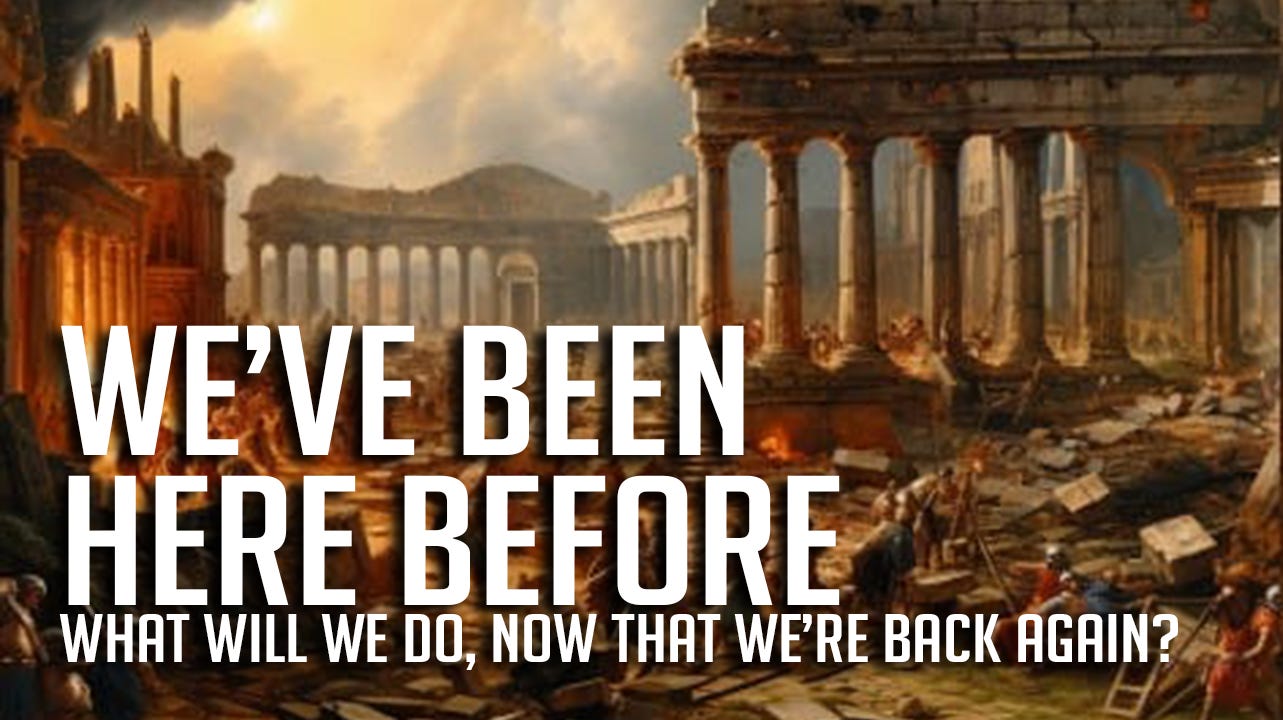
THE RUBBLE PROBLEM
Let me paint you a picture.
It’s the fifth century. The city of Rome — eternal Rome, the city that even its enemies couldn’t imagine not existing — has been sacked. Not once. Twice.
The legions that had held the border for centuries are either gone, bought off, or wearing the wrong team’s uniform. The emperor, to the extent there even is one, is a teenage boy who rules nothing and is about to be politely escorted into retirement by a Gothic warlord who has better things to do than pretend anymore.
The roads are still there. The aqueducts mostly work. The theaters are standing. But the civilization that built them — the great organizing project of Western antiquity — is gone. And ordinary people, from Roman senators -- to farmers in Gaul -- to merchants in Britannia, are all asking the same terrified question: Who’s in charge now?
The answer, as it turned out — the only answer that held — was: The Church.
Now fast-forward fifteen centuries, give or take, and I want to suggest that we’re living through a different kind of collapse. Not nearly as dramatic, at least -- not yet. Nobody’s sacked Washington, D.C. — though some would say the city is doing a reasonable job of that itself.
But the organizing worldview of Western civilization, the set of deep assumptions that held everything together and made the whole enterprise coherent, is fracturing. And once again, the question is being asked, whether people know it or not: Who’s in charge now? What holds us together? What do we actually believe?
And once again, I want to suggest that the Church — the people of Jesus, the community of the King — has both an answer and an opportunity.
That’s what this article is about.
THE CIVILIZATION THAT CHRISTIANITY BUILT
Let me start with what might seem like an audacious claim to some and an obvious one to others: Western civilization, as we’ve known it, was substantially built on a Christian foundation.
I know, I know. That’s going to make some people roll their eyes. We’ve all been through enough college classrooms and documentary series to have absorbed the counter-narrative — that the Church was the great oppressor, that Christianity held back science, that the real heroes of Western progress were the ones who finally got free of religion.
But here’s the thing about that story -- It’s historically illiterate. I don’t say that to be rude. I say it because the evidence is simply overwhelming in the other direction.
Vishal Mangalwadi — the Indian philosopher, social reformer, and author of the remarkable work -- The Book That Made Your World — spent decades studying exactly this question: Why did the modern world emerge from the West and not from India, or China, or the ancient Islamic world, all of which had more advanced civilizations at various points in history?
His answer is both simple and profound -- The Bible. THAT’S the Book that made our world. Not just “Christianity” as a vague cultural force, but the actual content of the Biblical worldview — its insistence on a rational Creator who made a rational cosmos, on the dignity of every human being made in God’s image, on the idea that truth is knowable and that reality is not an illusion, and on the belief that history is going somewhere and that human action matters.
Mangalwadi traces this through the rise of universities in medieval Europe — which were, almost without exception, founded by the Church.
Through the explosion of literacy that followed the Reformation, driven by Luther’s conviction that every German peasant should be able to read the Word of God for themselves.
Through the development of modern science by men like Copernicus, Kepler, Galileo, Newton, and Faraday — most of whom were devout Christians who believed they were thinking God’s thoughts after Him.
Through the abolition of slavery — driven not by Enlightenment philosophy, which often made peace with slavery, but by evangelical Christians like William Wilberforce who simply could not square the institution with the Imago Dei. --
Through the concept of limited government, of inalienable rights, of the rule of law rather than the rule of persons — all of which have deep roots in the biblical tradition and the Christian theology of human sinfulness, which, as C.S. Lewis once observed, is one of the strongest arguments for democracy; since every person is fallen and capable of abuse, no single person should hold unchecked power.
The historian Tom Holland — who’s not an evangelical Christian, and has said so — wrote a book called Dominion in which he argued, sometimes with personal discomfort, that the moral intuitions of the modern West are so thoroughly Christian in origin that secular people are still living off the interest of a bank account they’ve decided to stop believing in.
Ideas like human equality, concern for the poor, the dignity of the suffering, the rights of the individual against the state — these did not come from Athens. They came from Jerusalem.
This is not triumphalism. The Church has sinned terribly throughout history — the Crusades, the Inquisition,
territorial conquest done in Christ’s name, an accommodation of racism and slavery. All of that is real and must be honestly reckoned with. But the honest reckoning also has to include the fact that the very moral vocabulary people use to indict those failures is itself mostly Christian in origin.
The West was not perfect. But it was genuinely shaped, at its best and most creative, by the Christian worldview. And that matters enormously for understanding what is happening right now.
As has been documented by others, the Christian-Biblical Worldview that shaped Western Civilization has resulted in the highest standard of living, for the most people, with the greatest measure of personal liberty, for the longest period of time in history – BY FAR!
But just as the mighty Western Roman Empire, centered at what was deemed the Eternal City of Rome, collapsed from the weight of its own corruption, Western Civilization seems to be walking a similar path. The center is once again crumbling.
THE GREAT REPLACEMENT
So what happened?
The short answer is that the Christian worldview, which had provided Western civilization with its coherent foundation — its account of reality, human nature, morality, meaning, purpose — was gradually displaced by a competitor. We call that competitor secular humanism, though it wears many faces and goes by many names.
The displacement didn’t happen overnight. It was a long, slow process that began in earnest with the Enlightenment of the seventeenth and eighteenth centuries, when European intellectuals — reacting in part to the catastrophes of the Wars of Religion — began to argue that reason alone, unaided by revelation, was sufficient to build a just and flourishing society.
The Enlightenment project produced some genuinely beautiful things.
The language of natural rights.
A critique of arbitrary power.
A commitment to evidence and rational inquiry.
Much of all that wasn’t opposed to Christianity so much as it was downstream of it, using Christian moral capital in a secular vocabulary.
But the Enlightenment also produced children it didn’t intend but ought to have foreseen. The French Revolution, which went from liberté to the guillotine in about three years. The ideological totalitarianisms of the twentieth century — Marxism, Fascism, National Socialism — all of which were post-Christian projects that promised to build paradise on earth without God, and produced hell instead.
The brilliant G.K. Chesterton saw this coming. He observed that when people stop believing in God, they don’t believe in nothing — they believe anything. The transcendent object of devotion doesn’t disappear; it just gets transferred. To the nation. The race. The Party. To the arc of history. And finally, to the self – which circles us right back to the serpents appeal to Eve in Eden.
That last one — Self — is where we’ve for the most part, landed in the contemporary West. The dominant worldview of our moment isn’t Marxism or Fascism. It’s called “Expressive Individualism.” Carl Trueman describes and exposes it in his work of 2020 title The Rise & Triumph of the Modern Self.
Expressive Individualism is the belief that the authentic self is the supreme authority, that the purpose of life is to discover and express your inner truth, that any external constraint on that self-expression — whether from tradition, community, religion, or even biology — is oppression. And once you see it, and how Expressive Individualism IS the prevailing Worldview today, you can’t UN-see it. Rather, you see it EVERYWHERE.
Now, I want to be careful here, because I’m not saying everyone who holds progressive social views is a nihilist, or that everyone who has left the Church is living a meaningless life. God’s common grace is real, and image-bearers of God don’t stop being image-bearers when they stop believing in the One whose image they bear.
But I am saying that as a worldview — as a coherent account of reality capable of sustaining a civilization — secular humanism has a serious structural problem. It is, at its core, a parasite.
It consumes the moral capital built up by the civilization it replaced without being able to reproduce it.
It talks endlessly about human dignity without being able to explain WHY humans have dignity if there is no Creator who conferred it. It talks about justice without being able to ground justice in anything beyond shifting consensus. It talks about truth while simultaneously insisting truth is merely a social construct.
The result is what you see all around you: A culture that’s fragmenting. Not because it has too many ideas, but because it’s lost the shared grammar that allowed people to argue productively about ideas -- in the first place.
When there’s no agreed-upon source of moral authority — no transcendent reference point, no shared story, no common account of who we are and what we’re for — what remains is a Nietzschean Will to Power. The will to define reality becomes the only game in town. And that game, as history shows, is eventually won by whoever is most willing to use force. We are not at that point yet. But the trajectory is visible.
THE ROMAN PRECEDENT
Which brings me back to that fifth-century rubble heap.
The fall of the Western Roman Empire is one of the most studied events in history, and historians still argue about why it happened. In his influential work The Decline and Fall of the Roman Empire, Edward Gibbon famously blamed Christianity — the other-worldly religion, he argued, had sapped the martial virtues that kept the legions effective.
But that theory’s not aged well, given that the Eastern Roman Empire — equally Christian — survived for another thousand years. But -- it was a good story, and it fit the intellectual climate of Gibbon’s time. His fellow intellectuals were LOOKING for reasons to set Christianity aside.
More recent scholarship points to a combination of factors:
Economic overextension,
Agricultural exhaustion,
Climate disruption,
Plague,
Military overreach,
The increasing reliance on Germanic federates who had their own interests, and — maybe most importantly —
An elite class that had largely stopped believing in the civilization they were supposed to maintain.
Sound familiar?
But here is what’s undeniable about what came after. In the chaos that followed the collapse of imperial administration in the West, the Church was the only institution with both the institutional continuity and the ideological coherence to hold things together. As a result, people across the disintegrating Western Roman TURNED TO the Church to gather the dropped reins of steering society. When the mayor and city council left town, everyone turned to the local church’s pastor and elders.
Think about what that meant practically. The Roman administrative structure had depended on trained bureaucrats, literate record-keepers, judges who knew the law, tax collectors who understood the system.
When the empire fell, most of that talent base dispersed or died. But the Church had its own parallel structure — bishops in every major city, monasteries that preserved books and training, clergy who were often the only literate people in a region.
It was bishops like Ambrose of Milan and Augustine of Hippo — and later, figures like Benedict of Nursia, Gregory the Great, and Isidore of Seville — who became the intellectual and organizational spine of post-Roman Europe. The monasteries of Ireland and Britain, famously, preserved classical learning through the darkest decades when the continent was in chaos — what Thomas Cahill called, in his book title, How the Irish Saved Civilization.
This was not a power grab. Or rather, it was not primarily so. It was something more interesting. It was the Church simply doing what the Church does — caring for people, maintaining community, teaching the young, preserving knowledge, arbitrating disputes — and discovering, almost by accident, that it was the only institution left that could.
Charlemagne, the great Frankish king who came closest to reconstituting a Western empire in the early ninth century, understood this perfectly. His entire project of civilizational renewal was built on a partnership with the Church. He recruited literate clergy to staff his administration, established cathedral schools to train a new educated class, and built a legal and moral framework around Christian principles. The result was not a renewed Roman Empire — it was something new. Something that would eventually become – Europe.
The emergence of Europe as the world’s dominant civilization over the next millennium was not an accident.
It was the fruit of a thousand years of the Christian worldview being implemented, imperfectly and often bloodily, but persistently and pervasively, from top to bottom of society.
From the theology of the schools to the ethics of the merchant guilds. From the architecture of the cathedrals to the music of the choirs. From the laws governing marriage to the philosophy governing kingship.
Christianity didn’t merely influence European civilization. For a long stretch of history, Christianity WAS European civilization — its organizing logic, its animating spirit, its source of meaning and moral cohesion.
It can be again. But not in the same form. Not through political power or cultural dominance. But through the same mechanism it used the first time – Presence, faithfulness, service, and the inexhaustible power of the Gospel.
THE MANDATE THAT NEVER CHANGED
Here is the thing I want you to hold on to, because I think it is the most important point in this article.
The Great Commission has not been rescinded; it’s not been revised.
Before He ascended, Jesus said, “All authority in heaven and on earth has been given to Me. Go therefore and make disciples of all nations, baptizing them in the name of the Father and of the Son and of the Holy Spirit, teaching them to observe all that I have commanded you. And behold, I am with you always, to the end of the age.” Matthew 28:17-20
Jesus did not say: “Make disciples until secular humanism becomes dominant, then hand over the keys and wait for things to improve.” Our mandate to make disciples last to the end of the age. He did not say: “Make disciples as long as the culture is favorable and the institutions are supportive.” He faced eleven men in a backwater province of a vast empire that was actively hostile to the movement they represented — and that Empire, within three centuries, had largely capitulated.
The mandate HAS NOT changed. What has changed is the context. And honestly — and I say this as someone who loves the Church and has given fifty years of my life to it — the change in context may be the best thing that’s happened to us in a long time. Because here is a dirty little secret about the Church in a culture of Christendom: It gets lazy.
When Christianity is the default, when being a churchgoer is socially respectable, when you lose nothing by identifying as a Christian and might even gain something — like peer approval, social capital, a nice funeral — then the Church fills up with people who have the form of godliness but deny its power.
The nominal overwhelms the genuine. The institution goes through the motions while the life drains out.
That’s not the description of the Church in every age. But it’s an accurate description of significant stretches of Western church history. And it is, I would argue, a description of much of what called itself the American Church in the decades when American cultural Christianity was at its apparent peak.
But that’s over now. The nominal have largely self-sorted. The people showing up on Sunday mornings in 2026 are, by and large, people who’ve chosen to be there in spite of some cost. That’s not a tragedy. It’s the beginning of something. Because the Church that’s making disciples in a POST-Christian culture — the Church that’s countercultural not because it is trying to be cool but because its values actually differ from the surrounding culture — that Church is doing exactly what Jesus intended from the beginning. It is salt in the meat. It is light in the dark. It is leaven in the lump.
And here is the history lesson that should encourage you: that Church has changed the world before. It can do it again.
WHAT DISCIPLESHIP ACTUALLY DOES TO A CIVILIZATION
Let’s get concrete about this. Because I’m not talking about a political program or a culture-war strategy. I’m talking about what happens when the Gospel actually takes root in human lives and communities and begins to reshape them from the inside out.
Discipleship changes how people work. The Protestant doctrine of vocation — the idea that every occupation, not just religious work, is a calling before God — transformed the economies of Northern Europe.
When your labor is an act of worship, you bring to it a different quality of attention and integrity.
When your daily work is service to your neighbor in the name of Christ, it takes on a dignity that transcends the paycheck.
Discipleship changes how people relate to each other. The early Church was remarkable to pagan observers precisely because of its cross-class, cross-ethnic, cross-gender community. The early church father Tertullian quoted pagan observers of Christians. He reported them as saying, “See how they -meaning Christians - love one another.” That baffled pagans. People who had no business being in the same room — slaves and free, Jew and Greek, Roman matron and barbarian freedman — were sharing meals and calling each other brother and sister. That was not a social program. It was discipleship.
Discipleship changes how communities are governed. When people genuinely internalize the Gospel — when they believe that they will give an account to a holy God, that every person they deal with bears His image,
that they themselves are not the final authority — they govern differently.
The great reformers of Western law, from Gratian and his Decretum in the twelfth century to the framers of English common law tradition, were working within a framework shaped by Christian theology.
Okay - Not perfectly. Not without occasional corruption and failure. But the framework mattered.
And the Christian-Biblical worldview framework that underlay it all served as a self-correcting agent that exposed and corrected corruption.
Bottom Line -- THINGS. GOT. BETTER.
Discipleship changes how societies treat their most vulnerable. Before Christianity became a significant social force, infanticide was common across the Roman world. Gladiatorial games were entertainment. The poor had no organized system of care. The sick had family if they were lucky and the street if they weren’t.
The Church invented the hospital. It organized systematic care for the poor. The Church said ‘no’ to infanticide when the empire said yes. Not because Christians were naturally better people, but because they’d been formed by a story that said every human life is sacred.
This is what Mangalwadi means when he says the Bible made the modern world. Not that the Bible was dropped from the sky fully formed onto a grateful civilization. But that as the biblical worldview was taken seriously — argued about, preached, taught, argued about some more, applied in law and medicine and economics and family life — it produced a civilization unlike any that had come before.
Here’s the implication -- If a NOW secularized West is losing the things that made it worth living in, it’s not going to get them back through policy papers or TED talks or a new political coalition.
The fruit grows from the root. You want a civilization that treats its vulnerable with dignity — disciple people who believe the vulnerable bear the image of God. You want a civilization capable of self-governance — disciple people who are governed by conscience and accountable to someone higher than the state. As one American Founder said – “People will either be ruled by the Bible or the bayonet.”
You want a civilization with a shared moral vocabulary — disciple people in a shared moral story.
The Church is not the chaplain of Western civilization, called in to say nice words at the funeral. The Church is the carrier of the only worldview with the resources to rebuild what’s being lost.
THIS IS NOT A CALL TO POWER
I want to pause and make something clear, because I can already hear the objection being formed, and it’s a fair one.
I’m not calling for Christian nationalism. I’m not arguing that the Church should seize political power or that Christians should try to establish a theocracy. The history of the Church attempting to run civilizations through political dominance is — let me be honest — not pretty. The Constantinian settlement, the Holy Roman Empire, the Crusades, the Inquisition, the Wars of Religion — those are not templates. They are warnings.
I flatly reject Doug Wilson’s Christendom 2.0. What I’m describing is something different. Something older and more fundamental.
The Church did not Christianize the Roman Empire by winning elections or lobbying Caesar. It changed the Empire by making disciples — one person, one household, one community at a time.
By living differently. By loving sacrificially. By caring for the sick and poor in ways that the surrounding culture found incomprehensible. By refusing to recant when recanting would have been much more comfortable.
By the sheer stubborn excellence of a community organized around a different set of ultimate commitments.
The early Christians weren’t trying to take over Rome. They were trying to follow Jesus. And following Jesus turned out to be, historically speaking, extraordinarily culture-transforming.
So when I say the Church is the hope for Western civilization, I mean it in this sense -- A society is healthy to the degree that its people are genuinely oriented toward truth, goodness, and each other. And the only mechanism we have that actually forms people that way — at the level of desire and virtue and habit and love, not just behavior — is the Gospel and the community of people who live it out.
Alexis de Tocqueville understood that in 1835, when he came to observe the American experiment and tried to figure out why it was working when French-style democracy kept collapsing into chaos. His conclusion was that American democracy depended on the habits of the heart that religious community — especially Christian community — formed in its citizens. Take away the religion, and democratic self-governance becomes increasingly impossible, because it requires a level of self-restraint and regard-for-others that only something like genuine faith can produce at scale.
Tocqueville is increasingly being proved right. The answer is not more religion-as-civic-decoration. It is more genuine discipleship.
THE OPPORTUNITY IN THE RUINS
When Rome fell, the Church did not sit in the rubble lamenting the glory days of empire. It got to work. It cared for the sick and the displaced. It preserved knowledge. It baptized barbarians and taught them to read. It built schools and hospitals and eventually cathedrals. It argued theology with enormous seriousness because it believed theology actually mattered — that what you believed about God shaped what you believed about everything else.
In doing so — not in a century, not in two centuries, but over a very long obedience — it gave Europe a new civilization. Not a restoration of Rome, but something richer. Something that, at its best, drew on Rome’s gifts for law and order while adding a new insistence on human dignity, a new account of the common good, a new vision of what human flourishing actually meant.
We are being handed an similar moment. What will we do with it?
The cultural Christianity of the mid-twentieth century West is over. Lamenting it is useless. We’re not going back to 1955. Here’s what that means -- For the first time in centuries, Christians in the West are having to make a genuine choice. A costly one that’s clarifying.
It means the Church that emerges from this transition — if it takes the Great Commission seriously, if it invests in deep discipleship rather than shallow attendance, if it forms communities that are genuinely distinctive in their love and their ethics and their intellectual seriousness — that Church will have an opportunity that the comfortable Church of Christendom never had.
It’ll be visibly different from the surrounding culture. And visible difference — when it’s an attractive difference, when it is the difference of genuine love and truth and community — is the most powerful evangelistic tool in the history of the world.
The second and third century Church did not have the internet. It didn’t have religious freedom. It didn’t have publishing houses or podcasts or YouTube channels. It had the Gospel, and communities of people living the Gospel, and the winsome, world-altering power of a life transformed by encounter with the risen Jesus.
That’s still available. It’s not been cancelled. That is, in fact, the one thing the secular world cannot replicate, because it requires a power that the secular world does not have access to. The Holy Spirit is not subject to cultural trends.
So here is what I want to say to you — pastor, elder, deacon, small group leader, parent, teacher, youth worker, Sunday school volunteer, faithful lay person showing up every week: What you’re doing matters. Not just for eternity — though YES - absolutely for eternity. But also for history. For the civilization your grandchildren will inhabit.
Every genuine disciple you help form is a seed of a different future. Every person who learns to love their neighbor because they’ve first been loved by God is a brick in a more durable civilization. Every marriage that holds, every community that cares for its widows and orphans, every business run with genuine integrity, every conversation where truth is spoken in love — these are the materials from which a renewed culture is built.
It’s slow work. It was slow work before. The Church didn’t Christianize Rome in a decade. Benedict of Nursia didn’t stabilize post-Roman monasticism in a single generation. The Reformers didn’t change the church overnight — Luther spent decades writing, teaching, preaching, arguing, forming a generation of pastors.
But it worked. The evidence is all around us — in the hospitals named after saints, in the universities founded by bishops, in the legal codes shaped by natural law theory, in the music and art and literature of a civilization that, at its best, pointed toward the transcendent and treated human beings as worth the effort.
The secular experiment has had its run. It’s produced remarkable things — the scientific method, the technology, the material prosperity. But it’s running out of moral fuel. The tank is nearly empty. The Church has a full tank. The source is inexhaustible. And the mandate — to go and make disciples of all nations — is the same today as it was on that Galilean hillside two thousand years ago.
BACK TO THE RUBBLE
So let’s go back to fifth-century Rome one last time.
It must have felt to the people living through it like the end of everything. And in a real sense, it was. The world they’d known — the world their grandparents had known, the world that had seemed as permanent as the stone roads beneath their feet — was gone.
But something else was happening at the same time. In the monasteries, monks were copying manuscripts. In the church halls, bishops were mediating disputes and feeding the hungry. In the homes of ordinary Christians, people were gathering to pray and sing and share what they had.
The empire fell. The Church endured. And out of the Church’s endurance and faithfulness and obedience — over a very long, patient, imperfect, but persistent time — a new civilization grew.
I believe we are at a similar hinge point. I believe the Church in the West has been given a remarkable opportunity — not despite the cultural collapse around us, but because of it.
When the ambient noise of cultural Christianity fades, the genuine article becomes visible. When the secular project runs out of answers, people become newly open to ancient ones. When the world offers chaos and fragmentation, a community of genuine love and genuine truth shines like a city on a hill.
The mission hasn’t changed. The mandate hasn’t changed. The power certainly hasn’t changed. And the need — the desperate, aching, civilization-wide need for exactly what the Church carries — has perhaps never been greater.
So, go make disciples. Not because it will save Western civilization — though it might. Not because it will reverse the cultural decline — though it could. But because Jesus told you to. Because people are dying without Him.
And because the Gospel of the Kingdom is the only thing that has ever, in the long run, actually worked.
If this encouraged you, share it with someone who needs it. And if you want to go deeper on any of these themes — the history, the theology, the cultural analysis — I’ve got a lot more where that came from my on my YouTube channer - Into His Image channel.
God bless you. Stay faithful. The world needs the Church to be the Church.
Great insight into today, based on history…as always. Thanks Lance this is what we need to hear. Praying for God’s blessings on you in this ministry
Thank you @LanceRalston. Excellent and so timely and urgently needed. As I read u can hear your voice, as I hear the passion of God and zeal for His coming kingdom. Lord carry this word far and wide and plant it deeply in the hearts and minds of many. Truly the fields are white unto harvest, but the laborers are few, O LORD of the harvest send laborers we pray; Thy kingdom come, thy will be done in the earth as it is in heaven.