What the Machine Cannot Do
AI, Discipleship, and the Irreplaceable Work of the Church

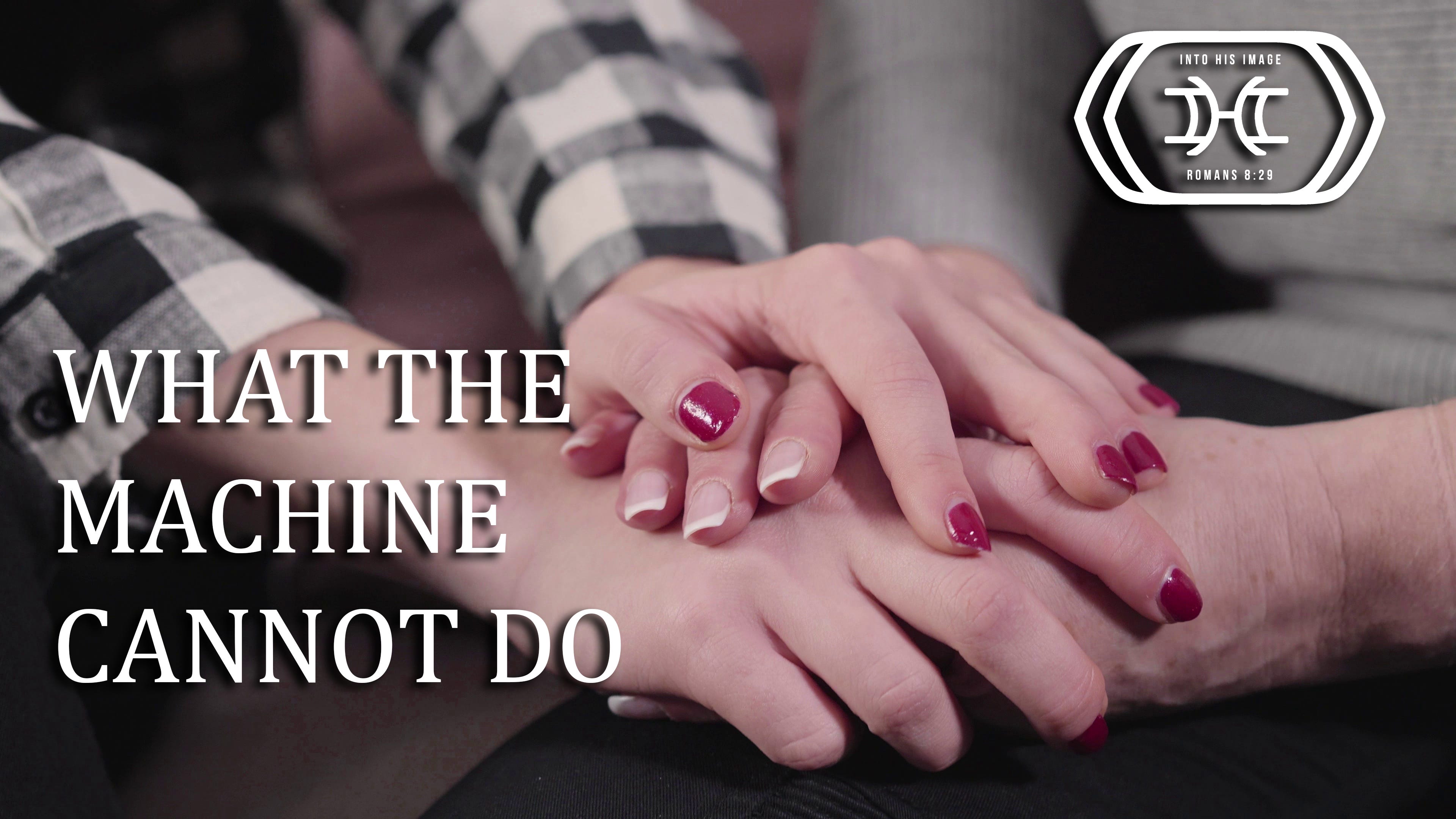
I just read an article here on Substack by my friend Miles DeBenedicitis who’s doing some amazing work in the field of AI. As he builds extremely effective AI tools, he’s raising important, dare I say, absolutely CRUCIAL questions about what AI is doing to our understanding of what it means to be human beings created in God’s image.
In his most recent article, Miles relates about a meeting he recently attended where someone told a room full of Christian leaders that if their organization was spending money on AI without reducing headcount and administration, they were probably wasting the money. He relates that most people in the room nodded their agreement. The speaker wasn’t being callous. He was being honest about the math.
As Miles shares in his article, AI can translate 4.5 million words of Bible commentary in an hour. What used to cost three-quarters of a million dollars and take five years now costs thousands and takes sixty minutes. No honest steward of kingdom resources looks at those two columns and chooses the old way. You use the tool. You reach the Urdu-speaking pastor in Karachi this year instead of in 2031. You say a quiet, painful “I’m sorry” to the human translators whose work was real and whose skill was genuine and whose livelihoods you are displacing. And then you keep going, because the mission demands it.
As a board member of a ministry that is translating our resources into multiple languages, I understand that math.
But I want to argue — urgently, pastorally, from the ground up — that while the math is real, it is not the whole story. Not for the Church. Because there is something the machine cannot do. There is something it will never do. And the Church, of all institutions on earth, should be the one that names it clearly and builds its life around it.
The machine cannot make a disciple.
The machine can fill an inbox, translate a commentary, and draft a sermon outline. It cannot sit across from a young man at a coffee shop and be the presence of Christ to him in his confusion.
What Disciples Actually Are
We’ve domesticated the word “discipleship” until it means something like “Bible study attendance” or “small group participation” or “completion of a curriculum.” None of those things are bad. Some of them are genuinely good. But the New Testament vision of a disciple is something much more demanding and much more beautiful than any of them.
A disciple is someone being conformed to the image of Jesus. That’s the language Paul uses in Romans 8 — being shaped, progressively, into the likeness of the Son. It is a transformation that touches character at its root:. How you treat the person who has wronged you, how you hold your anger, what you do with your pride, how you love the unlovable, whether you tell the truth when lying is easier, how you respond to suffering. These aren’t just nice ideas sequestered in some part of our heads partitioned for God’s Kingdom stuff. You can’t download them.
The reason is simple -- Character isn’t formed by information transfer. It’s formed by friction. By the sustained, sometimes uncomfortable, often inconvenient reality of living in close proximity to other people who are also broken and themselves being redeemed.
It’s formed in the moment when someone in your small group says something that irritates you and you have to decide, right then, whether to respond with grace or with sharpness.
It’s formed when a mentor tells you a hard truth about yourself and you have to sit with it.
It’s formed when you show up for someone in their grief at eleven o’clock on a Tuesday night because they called and you answered.
AI can’t do ANY of that. Not because it isn’t sophisticated enough (I should say ‘yet’) — but because formation requires a relationship between two image-bearers. It requires skin in the game. It requires the possibility of genuine sacrifice, genuine disappointment, genuine love. An algorithm can simulate the words of care. It can’t bear the cost of it.
Friction Is the Point
There’s a reason Jesus didn’t write a systematic theology and distribute it to the masses. He called twelve people and spent three years with them. He ate with them. He argued with them. He was patient with their slowness and their jealousy and their fear. He wept in front of them. He washed their feet. He let them see Him angry at the money changers and broken over Lazarus’s tomb and sweating blood in Gethsemane.
That’s how character is transmitted. By presence - Not information. By the long, slow work of one life poured into another.
The early church understood this. They devoted themselves to the apostles’ teaching, yes — but also to fellowship, to the breaking of bread, to prayer. Together. In one another’s homes. Selling possessions to meet one another’s needs. The Greek word Luke uses that is translated as “fellowship” is “koinonia’ It doesn’t mean “attending the same event.” It means a shared life. A genuine participation in one another’s existence.
The early church didn’t just share beliefs. They shared meals, resources, grief, and joy. That is the irreducibly human texture of discipleship that no technology can replicate.
This is not nostalgia. It is not a romantic preference for the old ways over the new. It is a theological claim about how God has designed human beings to grow. We are embodied spirits; relational creatures. We are made in the image of a God Who is Himself relational — Father, Son, and Holy Spirit in eternal communion. The shape of our formation has to match the shape of our nature.
The Opportunity in the Disruption
Here is where the disruption becomes, potentially, a gift — if the Church is wise enough to receive it.
Consider what consumes the average pastor’s week.
Email
Administrative coordination
Content drafting
Curriculum research
Meeting scheduling
Budget reporting
Communication logistics
By most estimates, a significant portion of a pastor’s time — and an even larger portion of church staff time — goes to tasks that are fundamentally informational and administrative. Tasks that AI can now do faster, cheaper, and in many cases better.
What if we let it?
What if the Church made a deliberate, strategic decision to hand over to the machine everything the machine can do, not primarily to reduce headcount or save money, but to recover time? Time for the pastor to sit with the grieving widow not for thirty minutes between meetings but for an unhurried afternoon. Time for the elder to disciple the young man who is quietly losing his faith. Time for the Sunday school teacher to know the kids in her class well enough to pray for them by name and by need. Time for the congregation to actually do life together instead of attending a series of well-organized events.
The earliest disciples didn’t have polished curriculum materials or podcast sermon archives or online giving platforms. They had each other. They had the Holy Spirit. They had the Word, and they had the community shaped by the Word.
They turned the world upside down.
We have more tools than they ever dreamed of. And in many ways, the Church in the West is producing fewer disciples per capita than at almost any point in its history. Something has gone wrong. And I don’t think the solution is more content, more programming, or better systems. I think the solution is more of what the machine can never replace: the irreplaceable presence of one blood-bought human being in the life of another.
What the Church Owes This Moment
The economic disruption coming from AI is real and it is serious.
Economists at Yale, Stanford, the Federal Reserve, and the University of Pennsylvania are now projecting labor force participation falling to levels not seen since the Great Depression, driven substantially by automation. The people who will be most affected are not the wealthy and the insulated. They are the working people who have built their lives around the kind of reliable, dignified labor that AI is now capable of replacing.
Many of those people go to our churches. Some of them work for our ministries. Some of them are about to lose jobs because a Christian organization ran the math and reached the same conclusion. The Church is not a bystander to this disruption. We are inside it.
That means the Church has something to offer this moment that is not merely spiritual comfort as an afterthought to economic reality. We have a community. We have a practice of presence. We have a theology of human dignity that says your worth is not located in your productivity. We have a table where the unemployed and the employed sit next to each other and eat the same bread and drink from the same cup.
We have the one thing the machine cannot manufacture: Each other.
In a world increasingly mediated by screens and algorithms, the Church’s most countercultural act may simply be showing up — in person, unhurried, for one another.
But we will only have the capacity for that kind of community if we are intentional about it. If we use the tools to free ourselves for the work the tools cannot do. If we resist the temptation to use AI to produce more content, more programs, and more efficient ministry operations, and instead use it to create margin — margin for relationship, for presence, for the long slow work of one life shaping another.
A Simple Proposal
I want to suggest something straightforward, almost embarrassingly simple:
Let AI do the busy work. Let it draft the newsletter, translate the commentary, schedule the meetings, research the curriculum, manage the database. Let it do all of that, and do it faster and cheaper than we ever could.
And then take the time it gives back and spend it with people. Actual people. In actual places. Eating actual meals, having actual conversations, bearing actual burdens. Being the Church in the way the Church was always meant to be — not a content platform with excellent production values, but a Body. A community. A family of broken people being slowly, painfully, gloriously conformed to the image of Jesus by the friction of life lived together.
The Great Commission is not “go and produce excellent discipleship content.” It is “go and make disciples.” Disciples are made in relationship. They always have been. They always will be.
The machine is a remarkable servant. It cannot be a shepherd. It cannot be a father in the faith. It cannot be the friend who sticks closer than a brother.
Only you can do that. Only we, together, can do that.
So let’s let the machine do what the machine can do — and then let’s go be the Church.
Lance Ralston is a pastor with over 40 years of ministry experience, a police chaplain, and a board member of Enduring Word.
This message really highlights something important about the limits of machines and the uniqueness of what God has placed inside human beings because while machines can process information and make decisions they cannot truly understand the depth of human experience love conscience and relationship It reminds me that human life is not just logic or data but something deeply spiritual because God created us in His image Genesis 1:27 and that means there is something in us that no machine can replicate What stands out is that machines can imitate thinking but they cannot possess true wisdom or discernment because wisdom comes from the Lord The fear of the Lord is the beginning of wisdom Proverbs 9:10 and that kind of wisdom is formed through relationship with Him not programming It also shows that machines cannot love or truly know God because love comes from a living heart Beloved let us love one another for love is from God and whoever loves has been born of God and knows God 1 John 4:7 and this kind of love cannot come from an algorithm There is also a reminder that as knowledge increases we must guard our hearts because Scripture says that lawlessness will increase and the love of many will grow cold Matthew 24:12 so we must stay rooted in Him Even in choices and decisions machines do not carry responsibility like we do because each of us will give an account of ourselves to God Romans 14:12 and that cannot be given to something without a soul In the end this reflection brings us back to trusting God above all things Trust in the Lord with all your heart and lean not on your own understanding Proverbs 3:5 because only He gives life wisdom and purpose beyond anything a machine can offer
Great post & follow up, Lance! I address a bit of this in my upcoming post but very pre-AI 😉